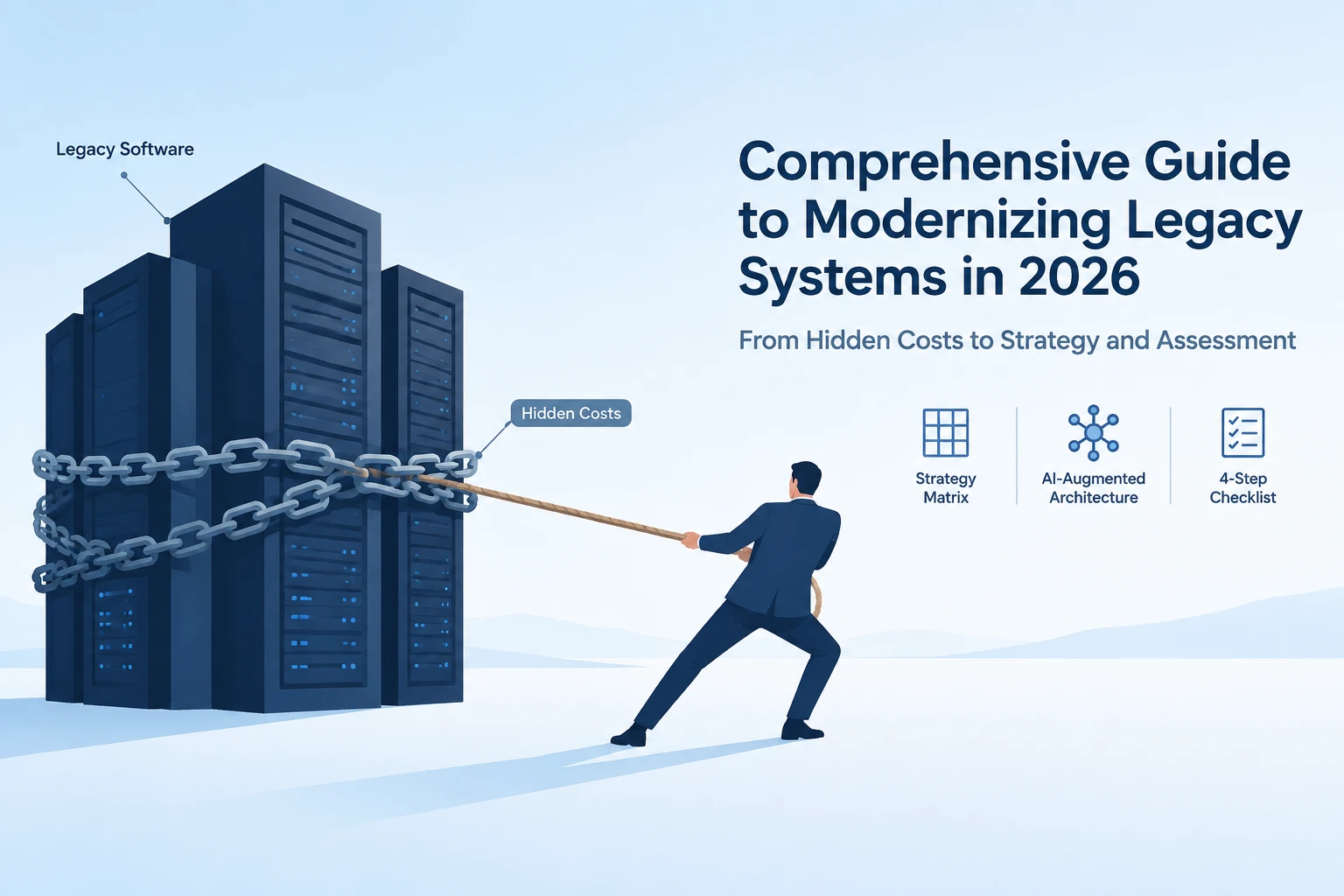
Enterprise software was supposed to be an asset that multiplied business growth. But for many companies, the code written between 2010 and 2020 has become a chain around development's ankle today and an obstacle to responding to market change.
The shifts in the technology ecosystem between 2020 and 2026 showed that agility is no longer an optional competitive advantage; it is a condition for survival. Organizations run on heavyweight architectures, messy databases, and people-driven processes not only pay staggering maintenance costs (OPEX) but also lose the ability to compete with agile rivals armed with automation.
1. What Exactly Is Legacy Software?
The engineering definition of Legacy goes beyond "old code." A system is called Legacy the moment that:
- Fixing and extending it is dangerous and expensive: even changing a single field in the database or adding a small feature threatens the stability of the whole system or produces cascading bugs.
- It depends heavily on key individuals: only one or two developers or long-tenured staff understand its inner workings, and in their absence the organization is disrupted.
- It lacks standard interfaces: no support for standard APIs (like REST or GraphQL) and Event-Driven patterns for connecting to AI and automation tools.
- Its user interface is complex and inefficient: processes that require dozens of clicks, lengthy staff training, and repeated manual data entry.
2. The Hidden Cost of Keeping Old Systems Alive
Believing that "a system that works today costs nothing" is a strategic mistake. The numbers from modernization projects show the following:
- Payroll Bloat: when software cannot reconcile data or run processes automatically, the organization is forced to employ a large team purely to shuttle data by hand between Excel files and the application.
- Compounding Technical Debt: every month of delay in modernization raises the future redesign cost by 20 to 30 percent.
- Severely Reduced Time-to-Market: while competitors launch new features within days, adding a capability to a Legacy system takes months.
3. Matrix of Modernization Strategies
| Strategy | Operational Definition | Risk Level | ROI Rate |
|---|---|---|---|
| Rehost (Lift & Shift) | Direct migration of infrastructure to the cloud without changing code architecture | Low | Low |
| Refactor / Replatform | Partial rework of application logic and connection to cloud services | Medium | Medium |
| Strangler Fig Pattern | Gradual, modular replacement of key components with a modern system | Highly controlled | Fast and continuous |
| Complete Rebuild (AI-Accelerated) | Full rewrite on a new architecture with intelligent acceleration tooling | Controlled | Very high |
Recommended Pattern: Step-by-Step Rollout with Strangler Fig
To prevent downtime, the Strangler Fig pattern is the safest path. In this approach, an intermediate layer (API Gateway / Facade) is placed in front of the existing software; then the costly modules are rewritten one by one on a modern tech stack, and traffic is gradually moved to the new core without any disruption to day-to-day operations.
4. Redesign with the Help of AI (AI-Augmented Architecture)
In 2026, AI is not merely a chatbot or a cosmetic widget — it shapes the core logic of the workflow:
- Eliminating manual layers with Autonomous Agents: software agents handle repetitive operations such as transaction reconciliation, ticket categorization, and document entry into the database, while humans play the role of Human-in-the-loop.
- Designing minimal, purpose-driven interfaces: cluttered pages with hundreds of fields are removed and replaced with context-aware dashboards and forms equipped with input prediction, bringing user error close to zero.
5. A 4-Step Checklist for Assessing Your Organization's State
- Onboarding Time: Does training a new hire on the system take weeks, or can it be done in a few hours?
- Time-to-Market: How long does it take to ship a new business capability?
- Data Access: Are decisions made from real-time reports, or does analysis require manually extracting reports?
- Maintenance Cost: What percentage of the IT budget goes to fixing bugs and keeping old servers running?
Frequently Asked Questions
Does modernizing software bring business operations to a halt?
No. By deploying patterns like Strangler Fig and event-driven data sync, the current system and the new platform run in parallel, and traffic is shifted without any outage.
How does AI reduce personnel costs?
By delegating repetitive tasks, document processing, and data entry to automation engines, the need for large operational teams disappears, and the organization moves toward a Lean model with high productivity.
If Technical Debt and aging infrastructure are preventing you from focusing on scaling the business, a specialized assessment session can clarify the path to a gradual transition and reduced operating costs.